Reviving and Protecting Traditional Organic Heirloom Pokkali Rice Farming Heritage of Kerala and India

Existing Public Policy protecting Pokkali farms EXCLUSIVELY for Pokkali Paddy Cultivation 14-April to 14-November (7 month Crop Calendar) as has been the case over centuries MUST be maintained and enforced. Encroachment and tresspassing of Pokkali farm lands from non-farming vested interests such as Eco-Tourism and Year-round Aquaculture by entities citing misleading and manufactured reasons for the lack of paddy cultivation must be prohibited. Pokkali cultivation is successfully being done by farmers from sowing through harvesting, as factually evidenced in Ezhikkara, Varappuzha, Kadamakkudy and Alappuzha without any of the issues cited by the Tourism and Aquaculture lobbies. These farmers need to be supported and their farming model needs to be promoted and replicated across all fallow farms.
Several farmers and entities are ready and willing to cultivate Pokkali Rice in the nearly 2000 heactare of fallow farms in Ernakulam District. Paddy cultivation is proven to be successful and profitable in these farms by genuine farmers in Ezhikkara, Kadamakudy and Varappuzha. Government must urgently regulate and incentivise fallow farm owners to either undertake 7-month Pokkali Farming themselves through to harvesting (not namesake sham cultivation attempts to collect govt crop loss subsidies) or make farm land available on a 7-month lease to willing farmers and entities for immediate Pokkali farming.
It has been proven by traditional practice over centuries that a 7-month Pokkali Crop Cultivation ENHANCES multi-fold associated 5-month Aquaculture Prawn yields and soil fertility. Existing Policy is a WIN-WIN for Pokkali and Prawn farming and is NOT a zero-sum proposition. Broad based policy change initiatives MUST NOT attempt to fix what is not broken. Tourism initiatives such as kayaking, motor boating, resorts etc should be moved off of Pokkali Farms to inland waters or adjoining rivers. Opportunitiies for traditional "Vanchi" boat rides amidst lush green Pokkali farms already exists and has been practiced by farmers over centuries to transport harvested crop. This can be offered as a truly authentic water navigation experience for tourists without need for any policy changes.
Several farmers and entities are ready and willing to cultivate Pokkali Rice in the nearly 2000 heactare of fallow farms in Ernakulam District. Paddy cultivation is proven to be successful and profitable in these farms by genuine farmers in Ezhikkara, Kadamakudy and Varappuzha. Government must urgently regulate and incentivise fallow farm owners to either undertake 7-month Pokkali Farming themselves through to harvesting (not namesake sham cultivation attempts to collect govt crop loss subsidies) or make farm land available on a 7-month lease to willing farmers and entities for immediate Pokkali farming.
It has been proven by traditional practice over centuries that a 7-month Pokkali Crop Cultivation ENHANCES multi-fold associated 5-month Aquaculture Prawn yields and soil fertility. Existing Policy is a WIN-WIN for Pokkali and Prawn farming and is NOT a zero-sum proposition. Broad based policy change initiatives MUST NOT attempt to fix what is not broken. Tourism initiatives such as kayaking, motor boating, resorts etc should be moved off of Pokkali Farms to inland waters or adjoining rivers. Opportunitiies for traditional "Vanchi" boat rides amidst lush green Pokkali farms already exists and has been practiced by farmers over centuries to transport harvested crop. This can be offered as a truly authentic water navigation experience for tourists without need for any policy changes.
Pokkali Farming Background
Internationally recognized and GI Tagged Traditional Heirloom Pokkali Paddy Cultivation is an Organic Agricultural Farming Treasure of Kerala and India. It is exclusive to the coastal brackish wetlands of Ernakulam, Alappuzha and Thrissur districts of Kerala. Over centuries, a 7 month Pokkali farming cycle aligned with monsoon fresh water has symbiotically coexisted with Prawn farming in the 5 month saline phase of the crop calendar. Pokkali harvesting leaves behind a nutrient rich farm eco system each season that delivers multifold Prawn farming yield.
Pokkali Farming Status
Alarmingly these traditional heirloom rice seeds passed on through successive generations and cultivation cycles are on the verge of extinction (some already extinct) driven by ineffective government policies, misuse of government crop loss compensation, introduction of non-native genetically modified seeds solely for higher yield at the expense of traditional quality, demographic shifts in labor force and source of economic livelihoods, lack of needed market placement and support pricing for this unique nutrient rich medicinal quality rice variety. Over 90% of farms are currently lying fallow due to owner neglect.
There is an urgent and critical need to revive Pokkali farming and its storied heritage in Kerala with the support of all those with goodwill both in the public and private sectors.
Urgently Needed Pokkali Revival Initiatives
-
Enforce Adherance to Pokkali Crop Calendar
Enforce compliance of time tested 7month Pokkali farming and 5month Prawn farming crop calendar and associated annual PLDA directives of District Collector. Hold farm owners, Padasekaram Committee Officials and Kettukarans (Prawn Farmers) responsible for non-compliance with prompt remedial action. There are several instances of widespread noncompliance every year. Promote successful and profitable symbiotic Pokkali and Prawn Cultivation practiced by genuine farmers in Ezhikkara, Alappuzha and Kadamakudy as a reference model to be emulated by owners of fallow farms. -
Stop Sham Cultivation and Enforce Prawn Farming Licensing
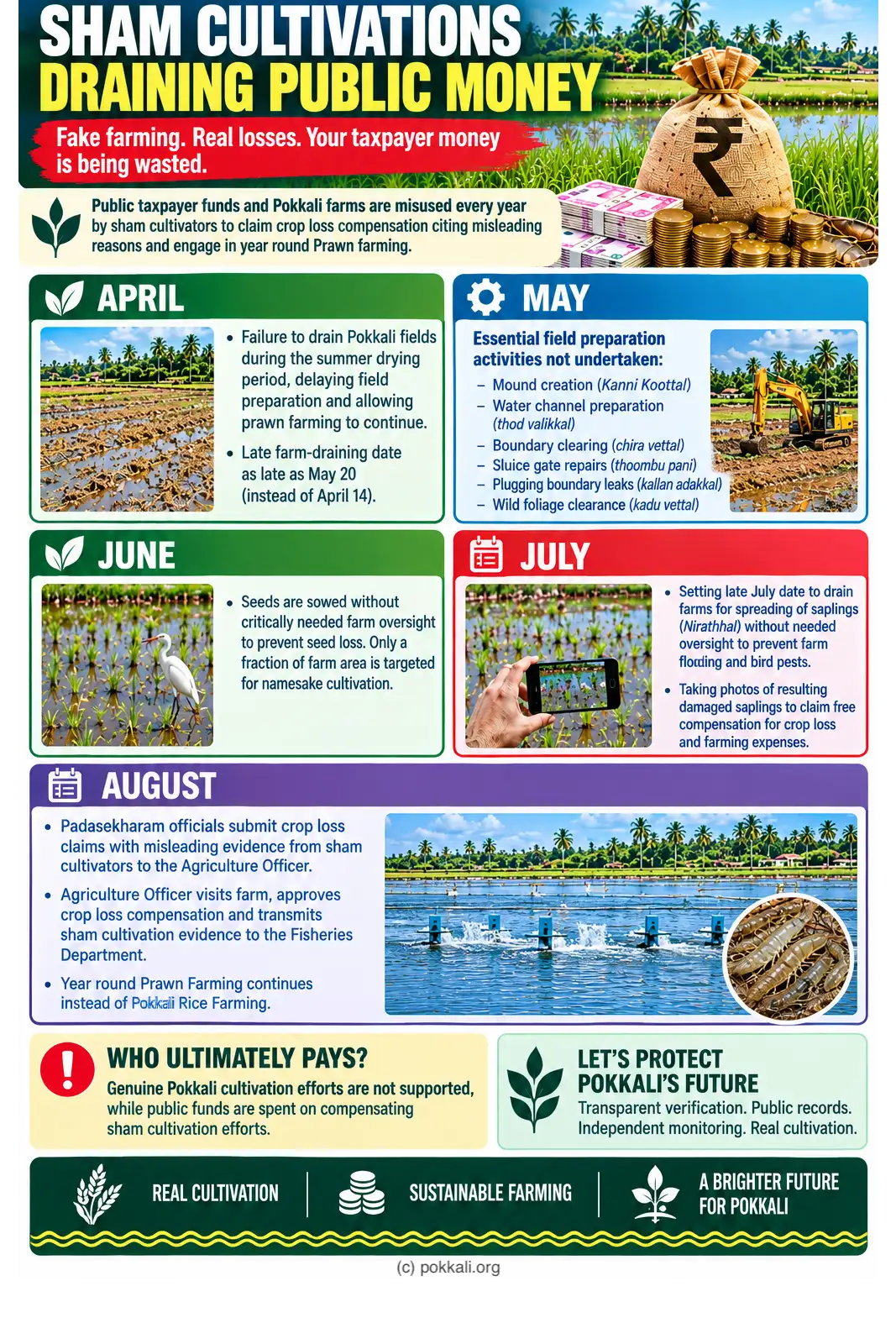
Prawn farming license to be issued only on successful verifiable photographic evidence of "harvesting" of Pokkali crop in atleast 80% of farm of farm owners. Identify unscrupulous Farm Owners, Padasekharam Committee Officials and Kettukarana who collude with Local Panchayath and Agriculture officials to disregard annual PLDA Directive to drain farms on 14-April and delay critically needed summer time farm preparation for Pokkali cultivation to as late as 20-May or 30-May, close to onset of monsoon. Misleading photographic evidence is submitted as reason for failed crop within weeks of sowing in less than 5% of farm (sham namesake cultivation attempt) to avail free government subsidies as a source of income and continue year round unauthorized Prawn farming. This is in sharp contrast to genuine Pokkali farmers in Ezhikkara, Kadamakudy and Alappuzha who are successfully cultivating and harvesting Pokkali crop by mitigating minimal to non-existent issues of birds, pests, labor, flooding, climate and market. -
Dedicate MGNREGA/VBGRAMG workdays for Pokkali Cultivation
Allocate minimum of 50 MGNREG/VBGRAMG labor work days per year during May/June/July and Oct months exclusively for revival of fallow Pokkali farms by clearing out foliage along cheras (boundaries), strengthening cheras, reinforcing sluice gates, ploughing fields, sowing, nirathhal (spreading) and harvesting. The new VB-G-RAM-G bill proposes 125 days work guarantee at average of Rs 400/day with a 40% contribution from State Government. Kerala State Government must step in and contribute the 40% to keep this lifeline alive for local village women labor force and allocate 50 workdays annually exclusively to revive Pokkali farming. Reduce existing 3 year fallow farm classification requirement to 1 year and extend support for at least 2 successive crop cycles. -
Promote Online Marketplace for Seeds and Rice
Provide single window online marketplace exchange for farmers to directly buy, sell and export traditional heirloom seeds and rice (not genetically modified) varieties at an MSP of Rs 100/Kg for seeds and Rs 150 to Rs 175/Kg for rice. Pokkali is a single-harvest-per-season crop unlike other 3 harvest rice varieties. Replicate successful model of public-private partnership for seed sales and marketing implemented by MLA and Agriculture Minister in Cherthala, Alappuzha district. -
Lease Fallow Farms for Pokkali Cultivation
Implement policies and direct farm owners who are unwilling or unable to farm, lease their existing fallow farms to willing 3rd party farmers and entities for 7 month Pokkali cultivation each year with appropriate profit sharing. Several farmers and entities are ready and willing to cultivate Pokkali Rice in the nearly 2000 heactare of fallow farms in Ernakulam District. Paddy cultivation is proven to be successful and profitable in these farms by genuine farmers in Ezhikkara, Kadamakudy and Varappuzha. Government must urgently regulate and incentivise fallow farm owners to either undertake 7-month Pokkali Farming themselves through to harvesting (not namesake sham cultivation attempts to collect govt crop loss subsidies) or make farm land available on a 7-month lease to willing farmers and entities for immediate Pokkali farming.
-
Maintain Online Farm Ownership and Usage Records of Pokkali Farms
Direct Agriculture Officer to maintain up to date online maps of farms, farm ownership contact details and cultivation records. Issue govt subsidies and compensation only to farm owners who demonstrate adherence to proper and timely Pokkali farming practices. -
Provide Multi-season Seed Vault for Pokkali Seeds Preservation
Develop temperature and humidity controlled seed vault to safeguard traditional heirloom Pokkali seed varieties for at least 2 farming cycles to eliminate risk of seed extinction. Generate and maintain a genomic marker database of all Pokkali rice varieties for rapid authentication, classification and certification. -
Provide Leasing of Automation Equipments for Pokkali Farmers
Provide inventory of farming automation equipment for farmers to lease including low cost programmable drones for bird and pest deterrence, drones for sowing and spraying, dried clay farm tillers, mechanized equipments for threshing and drying. -
Prioritize Pokkali Crop Harvest Success Incentives and Subsidies
Prioritize crop harvest success financial incentives instead of crop loss. Allocate subsidies with photographic evidence with 10% for traditional seed procurement, 10% post farm preparation, 10% post sowing, 10% post Nirathhal and 60% after successful crop harvest, with photographic evidence, in at least 80% of farm of owner. Agriculture Officer to be held accountable for needed compliance. -
Promote Responsible Tourism Initiatives in Pokkali Farmlands
Promote Responsible Tourism initiatives along Pokkali farm lands by highlighting authenticity of traditional farming practices, native bio-diversity and ecological balance. Provide financial tourism incentives only to farm owners who demonstrate successful Pokkali harvesting evidence in 80% of their farm. Prohibit repurposing of farm lands for resorts, parking lots, concrete tea houses (use traditional bamboo structures instead), disruptive water sports, motor boats, tourist overruns and pollution. -
Facilitate Rapid NPOP Organic Certification for Pokkali Farmers
Government should extend one time financial assistance of up to Rs 20K per farmer and facilitate fast tracking of NPOP Organic Certification of farms of willing farmers who can demonstrate successful harvesting of traditional heirloom variety of Pokkali rice in atleast 80% of their farm without any external source of contaminations, chemicals or pesticides during both Pokkali and Prawn crop calendar. This enables premium market placement and pricings for their harvest including exports at price points upwards of Rs 800/Kg at par with similar high quality organic rice offerings worldwide. -
Mandate Pokkali Farming Knowledge in Agriculture Degree Curriculum
All students pursuing an Agriculture Degree in Kerala must be taught about Organic Pokkali Farming practices of Kerala and the need for revival as a requirement for graduation. Prescribed textbooks must contain sufficient level of details of this farming methods. This ensures that all levels of Agriculture Department Officials including PAO, DDA, ADA and AO are aware of the Pokkali Farming practices and associated challenges when they get transferred to the coastal regions of Ernakulam, Alappuzha and Thrissur Districts. They will also have the ability to filter out misleading photos and justifications sent up the chain by unscrupulous Padasekharam Committee Officials or Local Self Government officials or Chemmeen Kettukarans (Prawn farmers) with vested interests to justify crop loss and improperly claim government compensations as literally another source of income.
Sham Cultivations Draining Public Taxpayer Money